


The method looks wrong at first.
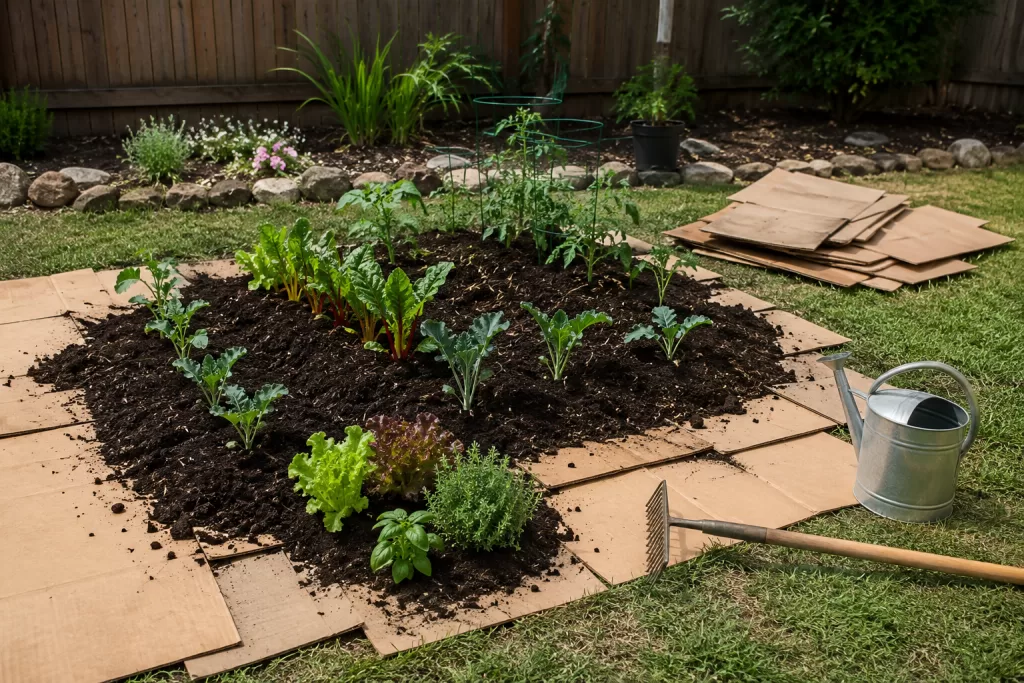
Instead of removing the grass, turning over the soil or using a tiller, gardeners place sheets of ordinary cardboard directly over the lawn.
They wet the cardboard, cover it with compost and begin planting into the new layer.
Videos showing the transformation have spread widely across social media, where the technique is often presented as a quick way to create a vegetable garden without digging.
The method is real, but it is not a new internet invention. It is a form of no-dig gardening promoted for decades by growers including British gardener Charles Dowding. The Royal Horticultural Society also recommends cardboard as one way to suppress grass and weeds when creating a new no-dig bed.
Why the cardboard is placed directly over grass
Cardboard blocks light from reaching the plants underneath.
Without enough light, grass and many annual weeds weaken and die. Meanwhile, moisture softens the cardboard and soil organisms gradually break it down.
The layer is not intended to remain permanently underground.
Dowding explains that cardboard beneath compost can soften within two or three months, allowing plant roots to grow through it and into the soil below. New seedlings can be planted immediately into the compost while that process is happening.
The technique avoids turning buried weed seeds back toward the surface and leaves much of the existing soil structure undisturbed.
What you need
For a bed approximately 1.2 metres wide and 2.4 metres long, prepare:
- plain brown cardboard;
- enough compost to create a layer 10 to 15 centimetres deep;
- water;
- a rake;
- vegetable seedlings or seeds;
- optional wooden, metal or stone edging.
Remove all plastic tape, labels and metal staples from the cardboard.
Do not use glossy, waxed or heavily printed boxes. The RHS advises overlapping the sheets so weeds cannot grow through open gaps.
How to make a no-dig cardboard bed
1. Cut back tall vegetation
Mow the grass or cut tall weeds close to the ground.
Remove woody plants, brambles and large perennial weed crowns. Cardboard can weaken many weeds, but aggressive perennial roots may survive and require additional attention.
There is no need to remove ordinary lawn grass.
2. Cover the entire area
Open the cardboard boxes into large flat sheets.
Place them directly over the ground, overlapping every edge by at least 10 to 15 centimetres. Use a double layer where the grass is thick or weeds are vigorous.
Extend the cardboard slightly beyond the planned bed so plants cannot emerge immediately around the edges.
3. Wet the cardboard
Water the sheets until they lie flat against the ground.
Moist cardboard is easier to cover and less likely to move in the wind. It also begins decomposing faster.
Avoid leaving exposed cardboard uncovered for long periods.
4. Add compost
Spread compost directly over the wet cardboard.
Charles Dowding commonly recommends placing the less completely decomposed material near the bottom and the finest compost at the surface, where seeds and young plants will grow.
For a new bed over lawn, use a generous first layer. Around 10 to 15 centimetres gives seedlings enough material to establish while the cardboard and grass underneath break down.
Rake the surface level and firm it gently.
5. Plant immediately
You do not necessarily have to wait several months.
Seedlings such as lettuce, kale, courgettes, tomatoes, chard and herbs can be planted directly into the compost. Small seeds can also be sown into the upper layer when the compost is fine enough.
Dowding specifically advises planting straight into newly made beds, including those with cardboard underneath.
Keep the bed consistently moist while roots are developing.
Why the method became viral
The transformation is easy to show in a short video.
One moment there is an ordinary patch of lawn. Cardboard boxes are spread across it, compost is added, and the final shot shows neat rows of vegetables.
The method also appeals to beginners because it avoids one of the hardest parts of starting a garden: removing turf by hand.
A 2026 examination of the viral cardboard technique noted that it can simplify the creation of a bed and reduce some weed growth, but it does not eliminate normal garden work. Plants still require watering, feeding, pruning and occasional weeding.
What can go wrong
The compost layer is too thin
A shallow layer may dry quickly and provide too little space for young roots before the cardboard softens.
Use a deeper layer when creating a bed over established lawn.
Gaps are left between sheets
Grass and weeds can grow through small openings.
Overlap the cardboard generously rather than placing the edges side by side.
The wrong cardboard is used
Glossy coatings, plastic tape and staples should not be buried in a vegetable bed.
Use plain corrugated cardboard and remove anything that will not decompose.
Persistent weeds return
Bindweed, couch grass and other strong perennial weeds can survive beneath cardboard or emerge around the edges.
Monitor the bed and remove new shoots before they become established.
The bed becomes dry
Compost placed above cardboard can dry faster than the soil below during warm weather.
Water deeply enough to moisten the entire upper layer, especially during the first season.
Does no-dig mean no work?
No.
The method removes most of the initial digging, but it does not create a maintenance-free garden.
Gardeners still need to water, harvest, manage pests and replenish organic matter. Established no-dig beds are usually topped with a thinner layer of compost each year rather than being rebuilt from the beginning.
The main difference is how the soil is treated.
Instead of repeatedly turning it over, compost is added to the surface. Worms and other organisms gradually carry organic material downward.
The simplest place to begin
A small bed is better than covering the entire yard at once.
Choose a sunny area close to a water source and make the bed narrow enough to reach the centre without stepping on it.
Cover the grass, add compost and plant a few reliable crops.
The cardboard will disappear gradually beneath the surface.
What remains is not a cardboard garden, but an ordinary vegetable bed created without removing the lawn or digging through the soil first.


